Showing posts with label Japanese. Show all posts

Friday, August 22, 2014

NOH & KYOGEN

THE SHOGUN & NOH'S EARLY YEARS

Shogun Ashikaga Yoshimitsu

During the Muromachi period in Japan, 1374, the third shogun witnessed a performance by Zeami Motokiyo and his father, Kan'ami Kiyotsugo.

Shogun Ashikaga Yoshimitsu would not only become a particular admirer of the young Zeami, but a significant patron of the emerging art form. Under his patronage, Zeami developed the Noh form.

ABOUT THE MUROMACHI PERIOD

"The era when members of the Ashikaga family occupied the position of shogun is known as the Muromachi period, named after the district in Kyoto where their headquarters was [later]located. Although the Ashikaga clan occupied the shogunate for nearly 200 years . . . .

Despite the social and political upheaval, the Muromachi period was economically and artistically innovative. This epoch saw the first steps in the establishment of modern commercial, transportation, and urban developments. Contact with China, which had been resumed in the Kamakura period, once again enriched and transformed Japanese thought and aesthetics. One of the imports that was to have a far-reaching impact was Zen Buddhism. Although known in Japan since the seventh century, Zen was enthusiastically embraced by the military class beginning in the thirteenth century and went on to have a profound effect on all aspects of national life, from government and commerce to the arts and education.

Kyoto, which, as the imperial capital, had never ceased to exert an enormous influence on the country's culture, once again became the seat of political power under the Ashikaga shoguns. The private villas that the Ashikaga shoguns built there served as elegant settings for the pursuit of art and culture. While tea drinking had been brought to Japan from China in earlier centuries, in the fifteenth century, a small coterie of highly cultivated men, influenced by Zen ideals, developed the basic principles of the tea (chanoyu) aesthetic. At its highest level, chanoyu involves an appreciation of garden design, architecture, interior design, calligraphy, painting, flower arranging, the decorative arts, and the preparation and service of food. These same enthusiastic patrons of the tea ceremony also lavished support on renga (linked-verse poetry) and No dance-drama, a subtle, slow-moving stage performance featuring masked and elaborately costumed actors." (http://www.metmuseum.org/toah/hd/muro/hd_muro.htm)


A bit more about the competitions:
"The competition between noh troupes was brought onstage as formal performance contests called tachiai ("combined performances"), which were judged by the highest-ranking audience member -- in many cases, the shogun himself. Tachiai were usually included as part of the program at kanjin no, or subscription performances. Not surprisingly, the winners of such contests stood a much better chance of attracting the shogun's notice and receiving his patronage as a result. Although noh tachiai bear some resemblance to the tragic contests held at the Great Dionysia festival in fifth-century B.C.E. Athens, in which individual playwrights vied for victory, tachiai involved competition between performers, not the playwrights, or different troupes. Moreover, unlike the Athenian contests, in which selected tragedians had already received official sponsorship from the polis and were competing more for fame and glory (kleos) than for patronage per se, no tachiai held out the possibility that a rousing victory might elicit the admiration and long-term support of the shogun.
Tachiai typically involved the simultaneous or successive performance of a set piece or pieces by various actors from competing troupes. When performers took the stage successively, the order of the performances was determined by the drawing of lots (kuji wo hiku). . . . Even when noh troupes were not competing against one another in official tachiai, every noh performance was, in a sense, an informal contest against other troupes competing for the same sources of patronage" (Theatricalities of Power: The Cultural Politics of Noh by Steven T. Brown, 2001, p.11).
"In Fushikaden (Transmission of flower through forms; 1400-1418), Zeami makes it clear that although the goal of every performing art should be "to calm the hearts of a wide variety of people and move the feeling of high and low alike," . . . the success of noh in the Muromachi period depended upon the favorable response of the nobility (kinin). Zeami's conception of the nobility included members of the military elite (buke), such as the shogun and his high-ranking officers, as well as the court aristocrats (kuge). Zeami advised the noh actor to regard the attendance o the nobility as the foundation of one's performance -- going so far as to recommend starting a performance before its appointed time, if members of the nobility should happen to arrive early." (Theatricalities of Power: The Cultural Politics of Noh by Steven T. Brown, 2001, p.11-12)
Thus, "even at subscription performances, where multiple classes inhabited the same theater, the spacial distribution of the audience suggests" the shogun and his inner circle were the focus of performance. "Although the best box in the kanjin theater was set aside for the gods (kami), who were situated immediately opposite the stage in galleries reserved for nobility. .. the shogun and his closest advisors sat to the left of the god's box, whereas the shogun's principal wife and family sat to the right".
Commoners were permitted in the open, uncovered area below the stage.
"His writings focus fairly narrowly on transmitting a body of secret performance techniques that will enable the Kanze actor to succeed in the highly competitive capital. [. . . ] a kind of technical knowledge whose secrecy enables a family to sustain an economic living" (The Culture of Secrecy in Japanese Religion by Bernhard Scheid and Mark Teeuwen, 2013. p. 234).

Noh evolved out of
- the recitation & singing of popular ballads
- Sarugaku (see page here)
&
- Dengaku (see page here)


The early origins of Noh theater were mostly folk-type forms of rustic entertainment; Sarugaku, which was connected to Shinto rituals, Dengaku, a kind of acrobatics with juggling, which later developed into a type of song-and-dance, Chinese-derived dances, and recited and chanted ballads which formed part of the oral tradition of the people.
By the middle of the fourteenth century, these various sources seem to have been combined into a form of theater recognizable to modern audiences as Noh, although just what those early plays were like is hard to say.
There are plays believed by scholars to be by Kanami (1333-1385), but they seem to have been heavily revised by his son Zeami (1363-1443), and no surviving play can be securely dated to before their era.
Zeami is the prime figure in Noh, having written a vast quantity of plays for his troupe to perform, many of which are still regularly performed to this day. He also wrote a very famous treatise in 1423 on the skills and methods necessary for a Noh actor, and that document is still valid study for young actors.
What Zeami, inspired by his father, managed to create, was a theater of the Muromachi period (1336-1573), written in the upper-class language of the fourteenth century, but which looked back to the supposed Golden Age of the Heian Period (794-1185), by basing plays on people, events and even poetry of that era creating texts of astonishing richness and opacity.


The Four Seats of Yamato and Tachiai Noh


At that time both sarugaku and dengaku had formed groups known as the Sarugaku-za and the Dengaku-za. Each group had a leader who acted as the chief support for the performances. In Yamato there were four particularly strong groups: Yusaki-za, Sakado-za, Tobi-za and Enmai-za. These four groups became the four oldest noh schools that remain today the Kanze, Kongō, Hōsho and Komparu schools respectively.

It was each group’s desire to rise to be considered the best in the capital. For that purpose, they gathered to perform in a kind of arts competition known as tachiai noh. Whoever was the winner would be deemed the best and this led to a fiercely fought battle. Whoever was in the top seat would have the most influence on the development of the art. It can also be thought of as one of the reasons Zeami wrote his treatises “Fūshi Kaden.”


After the Introduction of Zeami


The founder of the Yuzaki-za, Kanami, adapted a form of storytelling dance from sarugaku called, kusemai. He was the first to introduce this kind of dance into noh. Kanami also created to famous noh Sotoba Komachi and Jinen Koji.

Kanami’s son, Zeami inherited noh from his father and perfected it. In the Muromachi Period, with the support of the shōguns’ Ashikaga Yosimitsu and Nijo Motoe, Zeami was able to develop his own art, borrowing the techniques of his rivals. It was during this time that Zeami developed his notion of Yugen or “mysterious beauty” which he included in a number of his mugen noh (phantasmal noh) including the masterpiece Izutsu which is one of over 50 noh that are attributed to Zeami’s hand. Even now the same poetry and prose that he wrote are still being performed.

Following the death of Zeami, his nephew, Onami and the son in law of Komparu Zenchiku, took over as head of the troupe and continued developing the art even as the Onin Wars destroyed the capital. As all this was happening, noh still played a very active role in the lives of the military commanders. Among them, Toyotomi Hideyoshi one of the great unifiers of Japan, took a great interest in noh and studied with a Komparu Tayū and commissioned noh with themes about himself to be created.

Recent and Modern Noh


Noh continued under the protection and patronage of the Tokugawa Shōgunate. The second Shōgun Tokugawa Hidetada made it a law that noh and kyōgen would be the official art forms of the shōgunate and that the four sarugaku troupes from Yamato and the newly formed Kita troupe would be recognized as the official licensed performance troupes. From this, noh’s standing in society was fixed and it continued to grow in popularity with both the elite and the commoners. To this day, it continues to refine itself, however the creative genius from the artists of the middle ages has been lost.

Following the fall of the Tokugawa Shōgunate, noh too was in crisis. The following Meiji Period (1868-1912) saw the birth of a new government and industrial system in Japan as well as a return of entertainment for ordinary citizens. Noh too went through a kind of transformation with the development of the iemoto system, the merging of noh and kyōgen into nohgaku, and the building of indoor noh stages. Recently, with the development of people practicing utai (vocal) and shimai (short dance) noh is poised to spread.

http://www.the-noh.com/en/world/history.html

Noh performer (credit: John W. Bennett)


An Introduction to Noh
Every culture in the world has its own theater. In Japan one of the most ancient forms of theater is Noh. The Noh theater found its form in the fourteenth century and continues in much the same form, with many of the same plays, in present day Japan. A Noh play portrays one all-encompassing emotion dominating the main character, the shite (she-tay). Whether jealousy, rage, or sorrow, all music, gesture, dance, and recitation are used to build the emotion to its final climax at the close of the play. Often the plays depict the return of a historical personage, in spirit— or "ghostly"— form, to the site of a significant event in his or her life. A warrior might return to the battle field, or young woman to the scene of a love affair. According to Buddhism of the fourteenth century, a person could not find spiritual release even after death if he still possessed a strong emotion or desire. To exorcise this emotion, the warrior might appear in his armor and recreate the battle in a dance. The dance would reveal his humiliation at suffering defeat.
Noh plays are extremely intense. In order to express something so abstract as an emotion, words are often inadequate. As the play progresses, then, dance and poetry are used to express the tortured heart. Other elements which contribute to an intensification of the mood are the bare simplicity of the stage which allows no distraction from the main character, and the gorgeous costumes of the main character himself. The stylized movements also help to focus the energy on the emotion rather than on the individual personalities. In Noh as in classical ballet, every movement is choreographed and often symbolic. There is no individual interpretation.
Aside from the main character there are one or sometimes two secondary parts, the waki. Usually they are priests attired in long dark robes. Like the audience, the secondary character is really there only to observe the tragedy enacted by the main character. Usually a play opens with the priest or other secondary character's entrance. He describes the scene which he wants the audience to imagine. The scenes are all actual spots in Japan. The main character may then enter disguised as a local person. The local person reveals to the secondary character the significance of the site. He then exits. He returns dressed as his true self with a mask and embroidered robes. From the time of his return to the stage, the secondary character generally remains seated to one side.
Masks are very important in the Noh and are worn only by the main character. The mask helps to raise the action out of the ordinary, to freeze it in time. For the Noh actor the mask of a particular character has almost a magic power. Before putting it on he will look at it until he feels the emotion absorbed within himself. When he puts on the mask, his individuality recedes and he is nothing but the emotion to be depicted.
A chorus sits to the side of the stage. The chorus often echoes the words of the characters, but it may also speak for them. Thus in a dialogue between the main character and secondary characters, the chorus may say the lines of either of them. This is of course according to the script and not improvised. Nothing on the Noh stage is improvised. The use of the chorus to recite the actors' lines make it seem as though the lines belong to no one: The actors are there but the emotion is not under anyone's control. It floats between actors and chorus and is further picked up by a sudden drum beat or drawn out by the flute.
There are usually four musicians who sit to the rear of the stage. Three play Japanese drums and one plays a flute made from bamboo. The drums give a very hollow thud while the flute has an eerie whistling sound. This eerie whisper is what draws the first actor out onto the stage and creates the other-worldly feeling necessary to Noh.
http://afe.easia.columbia.edu/special/japan_1000ce_noh.htm


Noh prints by Tsukioka Kogyo (月岡耕漁):
http://www.britishmuseum.org/research/collection_online/search.aspx?people=146511&peoA=146511-2-59

http://www.nohtrainingproject.org/

NOH STAGE

Noh Stage at Night


Noh stage at Itsukushima Jinja is said to be from 1590, the oldest in Japan
With the Great Torli (sacred gate) on Miyajima Island


This information about the Noh stage is from a wonderful site: the-noh.com.  
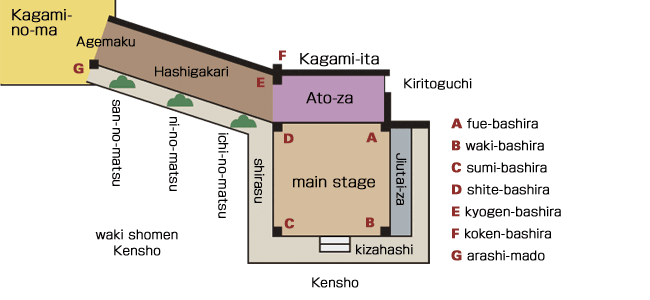
The noh stage is constructed from hinoki (Japanese cypress). At the back of the stage is the kagami-ita (back panel, usually displaying a painted pine tree). In the front of the stage is the kizahashi (decorative staircase). Coming off the left side of the stage is the hashigakari (bridgeway). At the end of the hashigakari is the agemaku (curtain) which marks the entrance to the backstage area. It is thought that this current standard stage construction was established just before the reign of the well known Shōgun Oda Nobunaga (circa 1550). The Northern Noh Stage, located Nishi Honganji Temple in Kyoto, is the oldest standing stage of this type of construction and is said to have been built by Toyotomi Hideyoshi.

The complete noh stage is comprised of the hon-butai (main playing area), hashigakari (bridgeway), ato-za (seating section for musicians and stage attendants) and the jiutai-za (seating section for the chorus). The main playing area is 5.4m per side.

http://www.the-noh.com/en/world/stage.html
 
Hashira
The main stage has four hashira or bashira (columns): the sumi-bashira, waki-bashira, shite-bashira, and the fue-bashira. As the shite wears a mask while performing, the hashira are a very important tool for the shite to gauge their location on stage. The sumi-bashira is a particularly important marker and also has the name metsuke-bashira or “eye-fixing column.”
Kagami-ita
The back wall of a noh stage is called the kagami-ita on which a pine tree called the oi-matsu is painted. This is said to be the eternal backdrop of noh. The Yōgō no matsu (The Yōgō Pine Tree) is said to be the model for which the kagami-ita is based, and can still be found at the Kasuga Shrine in Nara. While the noh stories may change, the backdrop does not. All noh are performed in front of the kagami-ita.
Jiutai-za and Ato-za
Off to the right side of the main playing area is the jiutai-za (seating for the chorus). The back of the stage is known as the ato-za and is the spot reserved for the hayashi (musicians) and the koken (stage attendants). In contrast to the main playing area where the boards lie vertically, in the ato-za the boards are laid horizontally, and is also known as the yoko-ita.
Hashigakari
Running from the ato-za off to the left of the main playing area is the hashigakari (bridgeway). The hashigakari is used not just for entrances and exits, but also as another playing area for some important scenes. As opposed to the openness of the main playing area, the hashigakari is linearly laid out and consequently aids in creating a feeling of depth. The shite then can use the hashigakari to better express their mental state.
Agemaku and Kiridoguchi
There are two entrances to the noh stage, the agemaku and the kiridoguchi or kirido. The agemaku is located at the end of the hashigakari and is the five-colored curtain that is raised and lowered for the entrance and exit of the shite, waki, tsure, waki-tsure, kyōgen, and hayashi. The kiridoguchi is located on the right side of the ato-za and is a small sliding door that is used for entrances and exits of the kōken (stage attendants) for both the shite and the hayashi, as well as for the jiutai (chorus).
Kagami-no-ma
The kagami-no-ma (mirror room) is located behind the agemaku and is where the shite puts on the mask being used for the noh. This is also where the hayashi play oshirabe (warm-up music). It can be said that when the shite and hayashi enter this area, the noh has begun.
Kensho
The audience seating area in a noh theatre is called the kensho. The seats located in front of the stage are called shōmen, while the seats on the left side of the stage are called the waki shōmen. Audience members sitting in the shōmen section have the best view of the mask effects, while the advantage of sitting in the waki shōmen is the close proximity to the hashigakari. In between the two are the naka shōmen seats which lie in front of the metsuke bashira. Older noh theatres have tatami rather than seats, while almost all large modern noh theatres are made with fixed seats. Some noh theatres are also equipped with balconies.
FROM: http://www.the-noh.com/en/world/stage.html, accessed Aug. 23, 2014.

Noh Production, Meiji era, 1897 by Tsukioka Kogyo (月岡耕漁)


INFO ON NOH PROPS: http://www.coreofculture.org/noh.html
A SEARCHABLE GLOSSARY OF NOH TERMS: http://db2.the-noh.com/edic/

NOH CHARACTERS, PLOTS & PLAYS


https://www.flickr.com/photos/tokyoviews/1954538146 4

Kanazawa Noh Museum


PLAY LINKS:
http://www.the-noh.com/en/plays/index.html

KABUKI


 http://www.kcpwindowonjapan.com/2011/10/kabuki-theater/


http://www.kabuki21.com/section.php


KABUKI STAGE


Interior of a Kabuki theatre, coloured woodcut triptych by Utagawa Toyokuni, c. 1800; in the British Museum.
Credit: Courtesy of the trustees of the British Museum & Britannica.com
Traditional and Modern


BUNRAKU

SARUGAKU


http://www.mfa.org/collections/object/a-sarugaku-performance-for-lord-higashiyama-higashiyama-dono-sarugaku-k%C3%B4gy%C3%B4-no-zu-51318 4

"Sarugaku(猿楽), literally "monkey fun", was a form of theatre popular in Japan during the 11th to 14th centuries. It originated from "sangaku," a form of entertainment reminiscent of the modern-day circus, consisting mostly of acrobatics, juggling, and pantomime, sometimes combined with drum dancing. It came from China to Japan in the 8th century and there mingled with indigenous traditions, particularly the harvest celebrations of dengaku. In the 11th century, the form began to favor comic sketches while other elements faded away. By the late 12th century, the term "sarugaku" had come to include comic dialogues based on word play (toben), improvised comic party dances (rambu), short plays involving several actors, and musical arrangements based on courtesan traditions. During the 13th century, there was increased standardization of words, gestures, musical arrangements, and program combinations; as well as the adoption of the guild (za) system to which all present-day Noh schools can be traced. Kyogen also developed from sarugaku. Of particular significance is the development of sarugaku troupes in Yamato around Nara and Kyoto during the Kamakura and early Muromachi periods. In particular, the sarugaku Noh troupe Yuzaki, led by Kan'ami, performed in 1374 before the young shogun Ashikaga Yoshimitsu. The success of this one performance and the resultant shogunal patronage lifted the artform permanently out of the mists of its plebeian past. From then, the term sarugaku gave way to the current nomenclature, Noh.
The Japanese term "Sarugaku" is also used in other contexts to refer to a job or profession that seems to debase the employee or to treat him or her as a source of entertainment rather than as a professional.[1]" - Wikipedia

During the Nara Period (710-794), a form of popular entertainment named sangaku was imported to Japan from China. This led to the development of sarugaku which included pantomime, acrobatics and magic; and gagaku, a more solemn form of music and dance. While gagaku was being performed for the noblemen and the imperial court at festivals and ceremonies, sangaku (or sarugaku as it became) was spreading throughout Japan being performed at shrines and on the roadsides.
As time went on and sangaku went through numerous changes, it took on the characteristics of noh and kyōgen and became known as sarugaku.
http://www.the-noh.com/en/world/history.html

KAGURA


Lion Dance by Chikanobu Toyohara - 1838-1912 (see this print on its original page by clicking on it -- UPDATE SOON)
SHINTO THEATRICAL DANCE - "GOD-ENTERTAINMENT"


NOTES

 FROM WIKIPEDIA
Kagura (神楽, かぐら, "god-entertainment") is a Japanese word referring to a specific type of Shinto theatrical dance—with roots arguably predating those of Noh. Once strictly a ceremonial art derived from kami'gakari (神懸, かみがかり, "oracular divination") and chinkon (鎮魂, ちんこん, "spirit pacification"), Kagura has evolved in many directions over the span of a millennium. Today it is very much a living tradition, with rituals tied to the rhythms of the agricultural calendar, as well as vibrant Kabuki-esque theatre, thriving primarily in parts of Shimane prefecture, and urban centers such as Hiroshima.[1]


History


Kagura stage
The epics Kojiki and Nihonshoki describe a folklore origin for the dances. In these texts, there is a famous legendary tale about the sun goddess Amaterasu, who retreated into a cave, bringing darkness and cold to the world. Ame-no-Uzume, kami/goddess of the dawn and of revelry, led the other gods in a wild dance, and persuaded Amaterasu to emerge to see what the ruckus was all about.[2] Kagura is one of a number of rituals and arts said to derive from this event.
Originally called kamukura or kamikura (神座), kagura began as sacred dances performed at the Imperial court by shrine maidens (miko) who were supposedly descendants of Ame-no-Uzume. Over time, however, these mikagura (御神楽), performed within the sacred and private precincts of the Imperial courts, inspired popular ritual dances, called satokagura (里神楽), which, being popular forms, practiced in villages all around the country, were adapted into various other folk traditions and developed into a number of different forms. Among these are miko kagura, shishi kagura, and Ise-style and Izumo-style kagura dances. Many more variations have developed over the centuries, including some which are fairly new, and most of which have become highly secularized folk traditions.
Kagura, in particular those forms that involve storytelling or reenactment of fables, is also one of the primary influences on the Noh theatre.

Imperial Kagura

The formal ritual dances (mikagura) were performed in a number of sacred places and on a number of special occasions. At the Imperial Sanctuary, where the Sacred Mirror was kept, they were performed as part of gagaku court music. Mikagura were also performed at the Imperial harvest festival and at major shrines such as Ise, Kamo, and Iwashimizu Hachiman-gū. Since around the year 1000, these events have taken place every year.
According to the ritual department of the Imperial Household Agency, kagura still take place every December in the Imperial Sanctuary and at the Imperial harvest festival ceremonies.


Satokagura, or "normal kagura", is a wide umbrella term containing a great diversity of folk dances derived from mikagura, and incorporated with other folk traditions. For the sake of brevity, a selection of traditions from the Kantō region will be used as examples.
  • Miko kagura – dances performed by shrine maidens (miko) originally derived from ritual dances in which the miko channeled the kami, speaking, singing, and dancing as the god. Though these originally had a very loose form, akin to similar god-possession dances and rituals in other world cultures, they have developed, like many other Japanese arts, into highly regular set forms. Today, they are performed largely in worship to kami at Shinto shrines, or as part of a ritual martial arts demonstration at Buddhist temples. These dances are often performed with ritual props, such as bells, bamboo canes, sprigs of sakaki, or paper streamers.
  • Izumo-ryū kagura – Dances based on those performed at Izumo Shrine serve a number of purposes, including ritual purification, celebration of auspicious days, and the reenactment of folktales. Originally quite popular in the Chūgoku region, near Izumo, these dances have spread across the country, and have developed over the centuries, becoming more secular folk entertainment and less formal religious ritual.


Susanoo and Orochi in Ise-ryū kagura
  • Ise-ryū kagura – A form of dances derived from those performed alongside yudate (boiling water) rituals at the outer shrines of Ise Shrine. Largely associated with Hanamatsuri (April 8), the miko or other group leaders immerse certain objects in boiling water as part of a purification ritual. As with other forms of kagura, this has become secularized and popularized as it transformed into a folk practice.
  • Shishi kagura – A form of lion dance, in which a group of dancers take on the role of the shishi lion and parade around the town. The lion mask and costume is seen as, in some ways, embodying the spirit of the lion, and this is a form of folk worship and ritual, as other forms of lion dances are in Japan and elsewhere.
See Petersen, David. (2007). Invitation to Kagura: Hidden Gem of the Traditional Japanese Performing Arts. Morrisville: Lulu Press.
 
Kagura hall (left) at Nikkō Tōshōgū, a Shinto shrine associated with the founder of the Tokugawa Shogunate
  • Daikagura – A form of dance deriving from rituals performed by traveling priests from Atsuta and Ise Shrines, who would travel to villages, crossroads, and other locations to help the locals by driving away evil spirits. Acrobatic feats and lion dances played a major role in these rituals.
Around the time of the beginning of the Tokugawa shogunate (1603-1868), performances derived from this emerged in Edo as a major form of entertainment. In connection with the celebrations surrounding the beginning of the shogunate, lion dances, acrobatics, juggling, and a great variety of other entertainments were performed on stages across the city, all nominally under the auspices of "daikagura". Over the course of the period, these came to be more closely associated with rakugo storytelling and other forms of popular entertainment, and still today, daikagura continues to be performed and to include many elements of street entertainment.

DENGAKU


http://ukiyo-e.org/image/mfa/sc13483 7

Dengaku (田楽)were rustic Japanese celebrations that can be classified into two types: dengaku that developed as a musical accompaniment to rice planting observances and the dengaku dances that developed in conjunction with sangaku. The dengaku celebrated for rice planting was performed by villagers either at the New Year or during the planting season in early summer. It was only in the 14th century that these dances were brought to the cities and incorporated into Noh theater, notably by the playwright and actor Kan'ami. The instrument of dengaku is the sasara, a wooden percussive instrument clapper, though there are other instruments that can be used.
In the Eiga Monogatari there is a detailed description of the rice-planting dengaku. After being brought to the aristocrats, dengaku flourished till the end of the Heian period and became the main performing art of the Kamakura and part of the Muromachi period.
By the end of the Muromachi, dengaku was eclipsed by sarugaku. Today it barely survives as a folk performing art.
Dengaku was closely linked with the native Japanese religion of Shinto. Ritualistic elements of this was incorporated with Sarugaku to form Noh theatre.

It is not clear when the word noh was first used, but long ago the word may have been used to describe all kinds of performances. From the Nambokucho period through to the Muromachi period, noh was widely divided into two categories called sarugaku noh and dengaku noh. Sarugaku noh was largely based on mimetic movements while dengaku noh was more associated with symbolic movement. And while dengaku noh was accepted by the nobility and performed largely in the capital, sarugaku noh was not accepted in the capital and played largely in Omi, Tanba, Ise and the areas surrounding the capital gaining popularity.
http://www.the-noh.com/en/world/history.html

BUTOH

ADD SUBTITLE IN CAPS HERE THEN HIT RETURN
Photo and Body Here

SUPER KABUKI

BUILDING FROM THE PAST

Super Kabuki

Ichikawa Ennosuke III -- “Yamato Takeru,” the first so-called super kabuki, combining traditional movement with modern technology  

FIELD TRIP

ADD SUBTITLE IN CAPS HERE THEN HIT RETURN
Photo and Body Here http://www.kanazawa-noh-museum.gr.jp/ http://www.ntj.jac.go.jp/english/
 
Copyright © 2014 Theater  History